
NAAC “A” Grade
India has one of the largest and most diverse education systems in the world. Privatization, widespread expansion, increased autonomy, and the introduction of programmes in new and emerging areas have significantly improved access to higher education. At the same time, these developments have also raised widespread concerns regarding the quality and relevance of higher education. To address these concerns, the National Policy on Education (NPE, 1986) and the Programme of Action (PoA, 1992) outlined strategic plans and advocated the establishment of an independent national accreditation agency. Consequently, the National Assessment and Accreditation Council (NAAC) was established in 1994 as an autonomous institution of the University Grants Commission (UGC), with its headquarters in Bengaluru. The mandate of NAAC, as reflected in its vision statement, is to make quality assurance an integral part of the functioning of Higher Education Institutions (HEIs).
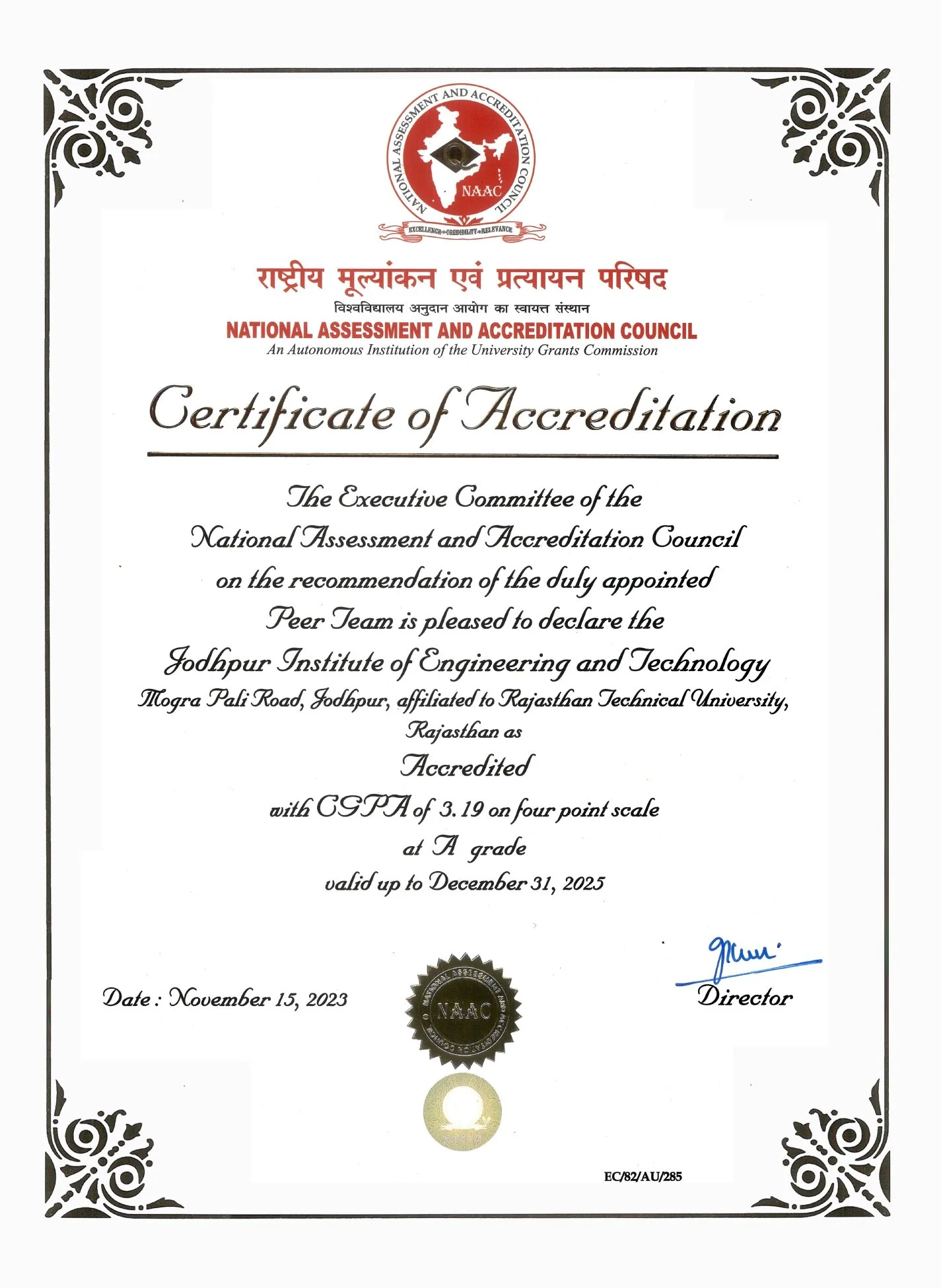
Jodhpur Institute of Engineering & Technology (JIET), located at Mogra, Pali Road, Jodhpur, and affiliated with Bikaner Technical University, Rajasthan, was accredited by NAAC with a CGPA of 3.19 on a seven-point scale and awarded an ‘A’ Grade, valid up to March 27, 2024. JIET is the only engineering institute in Rajasthan to have achieved NAAC ‘A’ Grade accreditation, reflecting its commitment to maintaining high standards of academic quality, institutional excellence, and continuous improvement.
Declaration

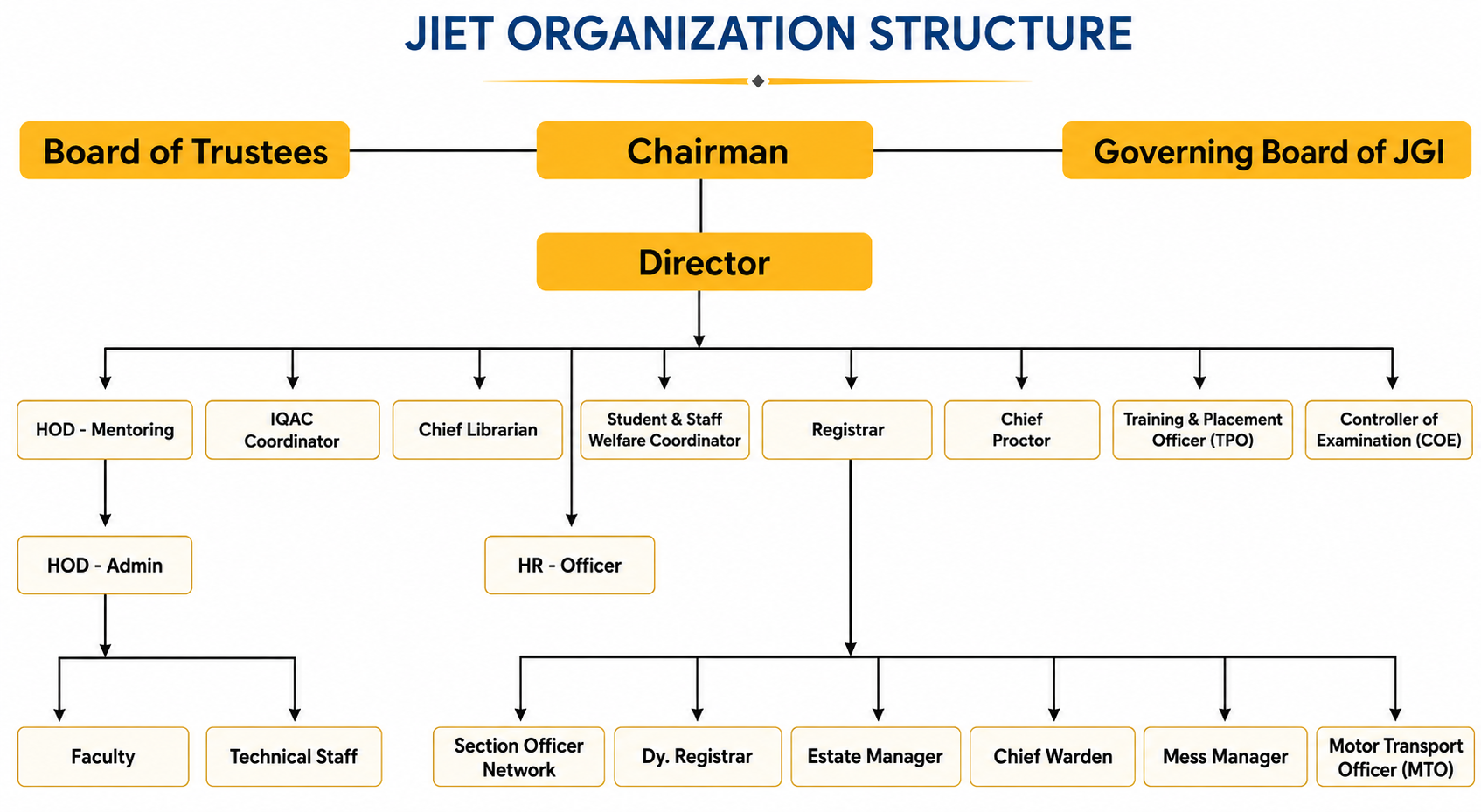
IQAC COMPOSITION
| SR. NO. | IQAC COMPOSITION | LINK |
|---|---|---|
| 1 | IQAC COMPOSITION 2026-27 | Click Here |
| 2 | IQAC COMPOSITION 2025-26 | Click Here |
| 3 | IQAC COMPOSITION 2024-25 | Click Here |
| 4 | IQAC COMPOSITION 2023-24 | Click Here |
| 5 | IQAC COMPOSITION 2022-23 | Click Here |
| 6 | IQAC COMPOSITION 2021-22 | Click Here |
| 7 | IQAC COMPOSITION 2020-21 | Click Here |
IQAC MOM & ATR
| SR. NO. | IQAC MEETING / MOM / ATR | LINK |
|---|---|---|
| 1 | MOM XVI - IQAC MEET JIET 2024-25 | Click Here |
| 2 | MOM XV IQAC MEETING | Click Here |
| 3 | ATR XV IQAC MEET | Click Here |
| 4 | XIV IQAC MEETING ATR 2024 | Click Here |
| 5 | XV IQAC MEETING MOM MAY 2024 | Click Here |
| 6 | XIII IQAC MEETING MOM 2022-23 | Click Here |
| 7 | XIII IQAC MEETING ATR 2022-23 | Click Here |
| 8 | XII - IQAC MEETING ACTION TAKEN REPORT | Click Here |
| 9 | I-III IQAC Meeting MOM & ATR | Click Here |
| 10 | IV-VI IQAC Meeting MOM & ATR | Click Here |
| 11 | VII-IX IQAC Meeting MOM & ATR | Click Here |
| 12 | X - IQAC Meeting MOM & ACTION Taken | Click Here |
| 13 | XII - IQAC Meeting MOM | Click Here |
| 14 | XI - IQAC Meeting MOM & ACTION 2021-22 | Click Here |
| 15 | XIV IQAC MEETING MOM SEPT. 30, 2023 | Click Here |
Policies
| SR. NO. | JIET POLICIES | LINK |
|---|---|---|
| 1 | JIET Policies | Click Here |
VARIOUS COMMITTEES AT JIET
IQAC Calendra
IQAC ACTIVITIES CALENDAR
| SR. NO. | ACADEMIC SESSION | LINK |
|---|---|---|
| 1 | 2026-27 - IQAC | Click Here |
| 2 | 2026-27 - DEPARTMENT | Click Here |
| 3 | 2025-26 | Click Here |
| 4 | 2024-25 | Click Here |
| 5 | 2023-24 | Click Here |
| 6 | 2022-23 | Click Here |
IQAC FEEDBACK CALENDAR
| SR. NO. | ACADEMIC SESSION | ACADEMIC CALENDAR | LINK |
|---|---|---|---|
| 1 | 2026-27 | ANNUAL ACTIVITIES CALENDAR | Click Here |
| 2 | 2025-26 | EVEN SEM | Click Here |
| 3 | ODD SEM | Click Here | |
| 4 | 2024-25 | EVEN SEM | Click Here |
| 5 | ODD SEM | Click Here | |
| 6 | 2023-24 | EVEN SEM | Click Here |
| 7 | ODD SEM | Click Here |
EXTERNAL PEER TEAM REVIEW REPORT
| S. NO. | ACADEMIC SESSION | LINK |
|---|---|---|
| 1 | 2025-26 | Click Here |
| 2 | 2024-25 | Click Here |
| 3 | 2023-24 | Click Here |
FEEDBACKS TAKEN BY IQAC
| SR. NO. | FEEDBACKS | LINK |
|---|---|---|
| 1 | COURSE FEEDBACKS | Click Here |
| 2 | CURRICULUM FEEDBACKS | Click Here |
| 3 | EXIT FEEDBACKS | Click Here |
| 4 | STUDENTS SATISFACTION SURVEYS | Click Here |
IQAC OF AQAR
| SR. NO. | AQAR YEAR | LINK |
|---|---|---|
| 1 | AQAR 2023-24 | Click Here |
| 2 | AQAR 2022-23 | Click Here |
| 3 | AQAR 2021-22 | Click Here |
| 4 | AQAR 2020-21 | Click Here |
| 5 | AQAR 2019-20 | Click Here |
| 6 | AQAR 2018-19 | Click Here |
FEEDBACKS TAKEN BY IQAC
| SR. NO. | FEEDBACKS | LINK |
|---|---|---|
| 1 | COURSE FEEDBACKS | Click Here |
| 2 | CURRICULUM FEEDBACKS | Click Here |
| 3 | EXIT FEEDBACKS | Click Here |
| 4 | STUDENTS SATISFACTION SURVEYS | Click Here |
INTERNAL QUALITY ASSURANCE CELL AUDIT & FEEDBACK CALENDAR
| SR.NO. | ACADEMIC SESSION | LINK | |
| 1 | 2026-27 | ANNUAL ACTIVITIES CALENDAR | Click Here |
| 2 | 2025-26 | EVEN SEM | Click Here |
| 3 | ODD SEM | Click Here | |
| 4 | 2024-25 | EVEN SEM | Click Here |
| 5 | ODD SEM | Click Here | |
| 6 | 2023-24 | EVEN SEM | Click Here |
| 7 | ODD SEM | Click Here | |
INTERNAL QUALITY ASSURANCE CELL ACTIVITIES CALENDAR
| SR. NO. | ACADEMIC SESSION | LINK |
| 1 | 2026-27 - IQAC | Click Here |
| 2 | 2026-27 - DEPARTMENT | Click Here |
| 3 | 2025-26 | Click Here |
| 4 | 2024-25 | Click Here |
| 5 | 2023-24 | Click Here |
| 6 | 2022-23 | Click Here |
VARIOUS COMMITTEES AT JIET
FEEDBACKS TAKEN BY IQAC
| SR. NO. | FEEDBACKS | LINK |
| 1 | COURSE FEEDBACKS | Click Here |
| 2 | CURRICULUM FEEDBACKS | Click Here |
| 3 | EXIT FEEDBACKS | Click Here |
| 4 | STUDENTS SATISFACTION SURVEYS | Click Here |
INTERNAL QUALITY ASSURANCE CELL MEETINGS
| IQAC MEETING | DATE OF MEETING | MINUTES OF MEETING | ACTION TAKEN REPORT |
| XXI MEETING | August 08,2026 | Click Here | Click Here |
| XX MEETING | June 22,2026 | Click Here | Click Here |
| XIX MEETING | March 14,2026 | Click Here | Click Here |
| XVIII MEETING | November 8,2025 | Click Here | Click Here |
| XVII MEETING | June 18,2025 | Click Here | Click Here |
| XVI MEETING | Jan. 11,2025 | Click Here | Click Here |
| XV MEETING | May 11,2024 | Click Here | Click Here |
| XIV MEETING | September 30,2023 | Click Here | Click Here |
| XIII MEETING | February 27,2023 | Click Here | Click Here |
| XII MEETING | November 12,2022 | Click Here | Click Here |
| XI MEETING | April 18,2022 | Click Here | Click Here |
| X MEETING | September 20,2021 | Click Here | Click Here |
| IX MEETING | April 24,2021 | Click Here | Click Here |
| VIII MEETING | December 15,2020 | Click Here | Click Here |
| VII MEETING | July 15,2020 | Click Here | Click Here |
| VI MEETING | December 20,2020 | Click Here | Click Here |
| V MEETING | October 19,2019 | Click Here | Click Here |
| IV MEETING | July 13,2019 | Click Here | Click Here |
| III MEETING | April 06,2019 | Click Here | Click Here |
| II MEETING | December 15,2018 | Click Here | Click Here |
| I MEETING | September 13,2018 | Click Here | Click Here |
INTERNAL QUALITY ASSURANCE CELL EXTERNAL PEER TEAM REVIEW REPORT
| S. NO. | ACADEMIC SESSION | LINK |
| 1 | 2025-26 | Click Here |
| 2 | 2024-25 | Click Here |
| 3 | 2023-24 | Click Here |
INTERNAL QUALITY ASSURANCE CELL ANNUAL REPORTS
| SR.NO. | SESSION WISE REPORT | LINK |
| 1 | ANNUAL REPORT 2023-24 | Click Here |
| 2 | ANNUAL REPORT 2022-23 | Click Here |
| 3 | ANNUAL REPORT 2021-22 | Click Here |
| 4 | ANNUAL REPORT 2020-21 | Click Here |
| 5 | ANNUAL REPORT 2019-20 | Click Here |
| 6 | ANNUAL REPORT 2018-19 | Click Here |
| 7 | ANNUAL REPORT 2017-18 | Click Here |
| 8 | ANNUAL REPORT 2016-17 | Click Here |
| 9 | ANNUAL REPORT 2015-16 | Click Here |
| 10 | ANNUAL REPORT 2014-15 | Click Here |
INTERNAL QUALITY ASSURANCE CELL AQAR
| SR. NO | AQAR YEAR | LINK |
| 1 | AQAR 2023-24 | Click Here |
| 2 | AQAR 2022-23 | Click Here |
| 3 | AQAR 2021-22 | Click Here |
| 4 | AQAR 2020-21 | Click Here |
| 5 | AQAR 2019-20 | Click Here |
| 6 | AQAR 2018-19 | Click Here |


FAQs
1 What is NAAC Accreditation?
NAAC's main duty is to assess and accredit all higher education institutions across the country. The Assessment and Accreditation (A&A) initiatives of the NAAC is very unique. It adopts a unique review process with a combination of quality evaluations, promotion and sustenance initiatives to offer grades to institutes.
2. What does NAAC stand for?
It is the acronym of the National Assessment and Accreditation Council. Holding a NAAC accreditation symbolizes a greater standard of excellence across your institution’s operations. With NAAC, institutions get the opportunity to,
- Square out its efficiency
- Realize its highlights and challenges
- Work on improvement plans for the betterment
3. What is NAAC’s vision?
NAAC's vision is to "make quality the defining element of higher education in India through a combination of self and external quality evaluation, promotion and sustenance initiatives". From a broader perspective, the NAAC has a 5-fold vision.
- To organize periodic assessment and accreditation of institutions, units, specific academic programs/projects of higher education
- To promote the quality of teaching-learning and research in the higher education academic environment
- To stimulate areas like self-evaluation, accountability, autonomy, and innovations
- To get involved in research studies, consultancy and training programs
- To foster stakeholder collaboration for quality evaluation, promotion, and sustenance. NAAC maintains or upholds the quality of HEIs through collaboration, stakeholder involvement, by bringing more accountability, transparency, and self-evaluation systems.
4. What is the benefit of NAAC accreditation?
Educational institution will know its strengths, weaknesses, opportunities and threats. Will be able to identify core areas of planning and allotment of resources. Data analysis & outcome provides funding agencies the objectives for performance funding.
5. What are the objectives of NAAC?
To encourage self-evaluation, accountability, autonomy and innovations in higher education; To undertake quality-related research studies, consultancy and training programmes, and • To collaborate with other stakeholders of higher education for quality evaluation, promotion and sustenance.
6. How long is the accreditation from NAAC valid?
The accreditation status awarded by NAAC is valid for a period of FIVE / SEVEN years as communicated in the Certificates issued.
7. Which is better NAAC or UGC?
UGC is University Grants Commission whereas NAAC is National Assessment and Accreditation Council. UGC approves a College or University whereas NAAC accredits the programs offered in the University or institute. NAAC is an accreditation body, which comes under the University Grants Commission of India.
8.Is NAAC A grade good?
Higher learning institutes in India are graded for each key aspect/ parameter under four different categories such as 'A', 'B', 'C', and 'D'. The NAAC grade denotes the performance of institutes such as very good, good, satisfactory, and unsatisfactory.
9. How is NAAC grade calculated?
The sum of the seven CrWGP divided by the sum of the pre assigned Weightages of the seven Criteria will result in Cumulative Grade Point Average (CGPA) of the institution. The institutional CGPA will be the deciding factor for accreditation status of the institution and its grade.
10. Who can apply for NAAC?
The two primary eligibility criteria for institutions to apply for NAAC Accreditation are: · The Institution must have at least two batches of graduated students. · The age of the Institution must be 6 years or above. What are the stages in the process of Assessment and Accreditation? The process for assessment and accreditation broadly consists of:
- Online submission of Institutional Information for Quality Assessment (IIQA) and Self-Study Report (SSR).
- Data Validation and Verification (DVV) by NAAC.
- Student Satisfaction Survey (SSS) by NAAC.
- Peer Team Visit.
- Institutional Grading.
11. What is Grade A colleges?
Colleges that have secured a minimum ‘A’ grade by National Accreditation Assessment Council (NAAC) shall only be granted ‘autonomous status, the revised guidelines of University Grants Commission (UGC) has outlined. In its revised guidelines of autonomous colleges, UGC has pushed for greater autonomy of colleges. Highlighting the importance of autonomous colleges, the UGC said, “The only safe and better way to improve the quality of undergraduate education is to delink most of the colleges from the affiliating structure.
12. What are NAAC Criteria and weightages?
NAAC critically focuses on getting a criteria-based assessment into the following seven areas of higher education.
- Curricular Aspects
- Teaching & Learning, Evaluation
- Research, Consultancy, and Extensions
- Infrastructure and Learning Resources
- Student Support and Progression
- Governance, Leadership, and Management
- Institutional Values & Best Practices
13. What is IQAC?
The Internal Quality Assurance Cell (IQAC) stands as the sole authority for quality sustenance in an institute, post its accreditation. They initiate, plan and supervise the quality matters. Therefore any institute that has achieved its NAAC status is sure to have an active IQAC in its premises.
14. What are the benefits to the students of NAAC Accreditation?
An edge over other university students · Gives an instant recognition to alumni that they hail from a credible institute, which ultimately improves the admissions. · Expands placement opportunity with international companies and industries showing high preference during placement · A definite chance for better academics, exposure with different peers, labs, workshops, opportunities, projects, etc · Accelerates exchange programs with tie-ups from other reputable universities abroad · Opportunities for further studies