
Great education begins with educators who never stop learning.
Technology is changing how we work, communicate, and solve problems. Naturally, the way we teach must evolve too. Today's students expect more than textbooks and lectures. They want practical knowledge, industry exposure, modern learning tools, and skills that prepare them for the future.
But who prepares the educators to meet these expectations?
This is where Faculty Development Programs (FDPs) make a difference.
Faculty Development Programs help teachers sharpen their teaching skills, explore emerging technologies, strengthen research capabilities, and bring fresh perspectives into the classroom.
At JIET Universe, Jodhpur, continuous faculty learning is an important part of the institution's approach to academic excellence, quality education, and innovation.
Let's explore why Faculty Development Programs are essential in higher education and how they contribute to better learning experiences.
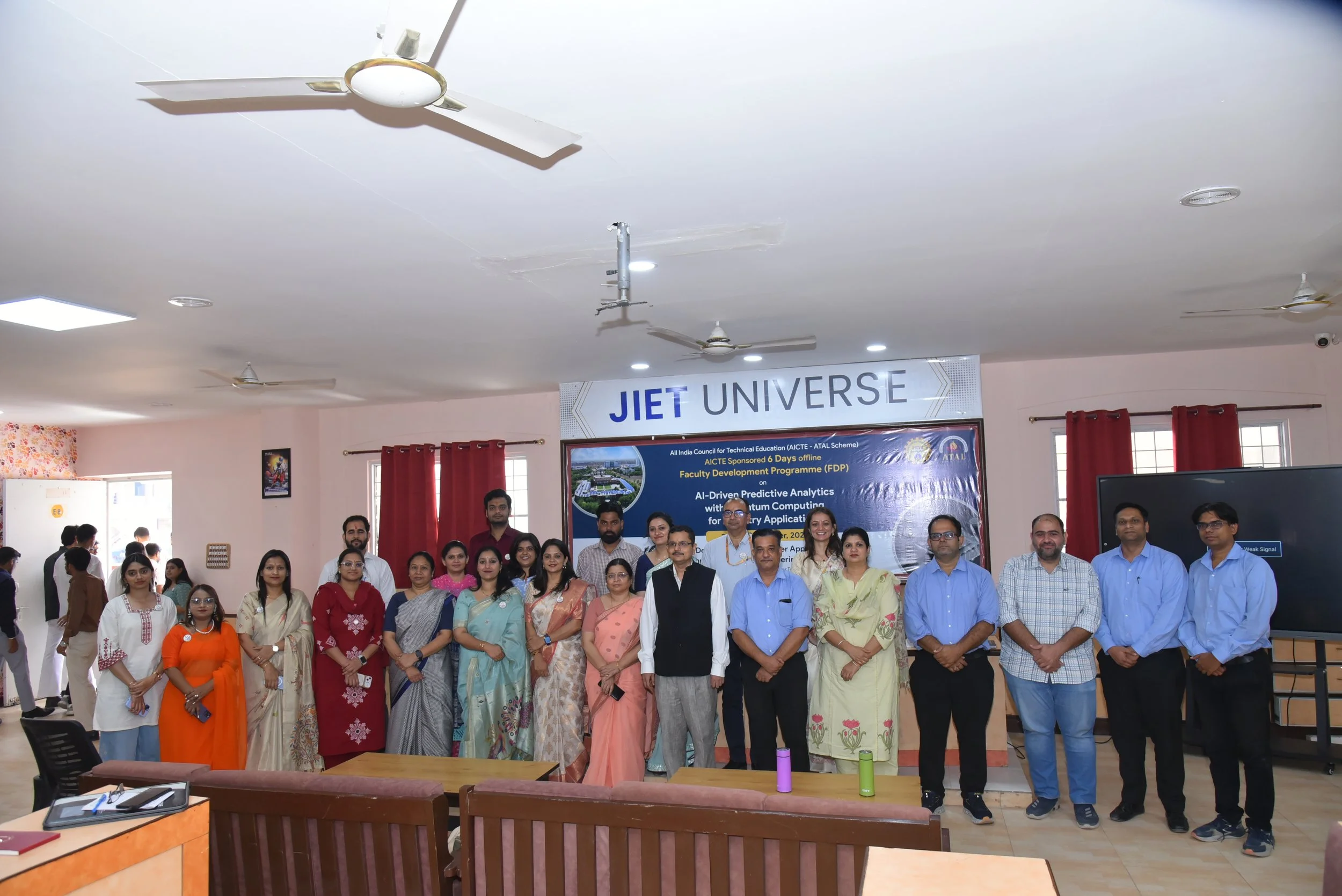
What Is a Faculty Development Program (FDP)?
A Faculty Development Program (FDP) is a structured training initiative designed to enhance the professional knowledge, teaching abilities, research skills, and technological competencies of educators.
Unlike conventional training sessions, an effective FDP encourages faculty members to rethink how they teach, engage with students, and apply knowledge in practical situations.
Faculty Development Programs in engineering colleges and universities commonly focus on:
Modern teaching methodologies and classroom engagement.
Artificial Intelligence, Machine Learning, and emerging technologies.
Outcome-Based Education (OBE) and Bloom's Taxonomy.
Research methodologies, academic publications, and innovation.
Industry-oriented learning and practical applications.
Academic quality assurance and professional development.
The objective is simple: help educators become more effective, adaptable, and confident in their academic roles.
1. Better Teaching Creates Better Learning Experiences
Think about a classroom where students only listen to lectures and take notes. Now imagine another where they solve real-world problems, participate in discussions, explore simulations, and work on practical projects.
The difference often lies in the teaching approach.
Faculty Development Programs introduce educators to methods that make learning more interactive and meaningful. Project-based learning, case studies, experiential activities, and digital teaching resources can encourage students to engage more deeply with their subjects.
For example, an engineering faculty member who learns to use simulation software can demonstrate concepts that may otherwise be difficult to explain through diagrams alone.
At JIET Universe, faculty development supports the broader goal of making education more application-oriented and student-centred.
2. Keeping Educators Updated with Emerging Technologies
Artificial Intelligence, automation, cybersecurity, data analytics, and digital technologies are transforming professional fields at a remarkable pace.
For educators, keeping up with these developments is no longer optional.
An FDP focused on emerging technologies can introduce faculty members to new tools, current applications, and opportunities to integrate technological developments into their subjects.
Consider an educator attending a workshop on Artificial Intelligence. Beyond understanding the technology itself, the faculty member may discover how AI can support data analysis, engineering applications, research, or academic workflows.
Such exposure helps educators connect established concepts with current developments.
For students, this can mean learning not only what a technology is, but also where and why it is used.
3. Strengthening Research Skills and Encouraging Innovation
Research is an essential part of academic life. It encourages educators to question existing knowledge, investigate new ideas, and contribute to developments in their respective disciplines.
However, conducting meaningful research requires more than subject expertise.
Faculty members must understand research design, data interpretation, scholarly writing, ethical practices, and emerging analytical tools.
Research-oriented Faculty Development Programs can help educators improve these skills while providing opportunities to interact with researchers and subject experts.
For institutions such as JIET Universe, supporting faculty research and innovation contributes to an academic environment where exploration and knowledge sharing remain important priorities.
A faculty member who develops stronger research capabilities can also guide students more effectively during research projects, dissertations, and technical investigations.
4. Bridging the Gap Between Classroom Learning and Industry
One of the most important questions in professional education is whether students can apply what they learn to practical challenges.
Industry expectations continue to evolve, particularly in engineering and technology-driven fields.
Faculty Development Programs involving industry experts, technical demonstrations, and application-based workshops can help educators understand how concepts are being used outside the classroom.
For instance, knowledge gained from a training session on smart manufacturing or data analytics may help a faculty member introduce relevant case studies, practical assignments, or project ideas.
This creates opportunities to connect academic knowledge with professional applications.
At JIET Universe, industry-relevant learning forms an important part of the broader discussion around preparing students for future opportunities.
5. Improving Outcome-Based Education and Academic Quality
Quality education is not determined solely by how much content is taught. It also depends on what students actually understand and can demonstrate after completing a course.
This is the central idea behind Outcome-Based Education (OBE).
Faculty Development Programs on OBE help educators understand Course Outcomes (COs), Program Outcomes (POs), Bloom's Taxonomy, assessment planning, and attainment evaluation.
These concepts may appear technical, but their purpose is practical.
For example, if students perform poorly on questions requiring application and analysis, faculty members can examine whether the teaching activities and assessments provide enough opportunities to practise those skills.
Such reflection helps make academic improvement more systematic.
Faculty development initiatives focusing on academic quality, assessment methods, and continuous improvement can support the institutional quality assurance efforts of JIET Universe.
6. Encouraging Collaboration and Fresh Perspectives
Some of the most valuable learning during an FDP happens through conversations.
A faculty member from Civil Engineering may discover a useful data analysis technique from a Computer Science educator. A discussion about student assessment may introduce a new approach that another department has successfully adopted.
These exchanges encourage educators to look beyond their immediate specialisations.
Faculty Development Programs bring together individuals with different experiences and expertise, creating opportunities for collaboration, professional networking, and interdisciplinary learning.
Such interactions can inspire new teaching ideas, academic initiatives, and research partnerships.
7. Helping Students Become Future-Ready Professionals
Although faculty members are the direct participants in FDPs, students are among the most important beneficiaries.
When educators gain new knowledge and improve their teaching approaches, students have more opportunities to experience updated course content, practical demonstrations, and meaningful academic activities.
Faculty development can contribute to:
Stronger conceptual understanding and analytical thinking.
Greater exposure to emerging technologies.
Improved problem-solving and project-based learning.
Better guidance for research and innovation.
Increased awareness of industry expectations and professional skills.
For engineering students, these experiences can support preparation for internships, higher studies, entrepreneurship, research, and employment.
The connection is clear: when educators grow professionally, they are better equipped to support student growth.
How JIET Universe Supports a Culture of Continuous Learning
Located in Jodhpur, Rajasthan, JIET Universe recognises the importance of adapting to changes in higher education.
Faculty development, research engagement, academic workshops, and knowledge-sharing initiatives form part of the institution's efforts to encourage continuous professional learning.
Topics such as teaching methodologies, Outcome-Based Education, research practices, and technology integration are relevant not only to individual faculty members but also to the overall quality of academic delivery.
The value of these initiatives extends beyond certificates and participation. Their lasting contribution comes when educators use their learning to improve classroom interaction, strengthen assessment practices, guide student projects, and explore new academic possibilities.
This is what makes faculty development meaningful: it transforms professional learning into opportunities for better education.
FAQ’s
Q1: What is the main purpose of a Faculty Development Program?
Ans. The main purpose of an FDP is to help educators improve their teaching, research, technological, and professional skills so they can respond effectively to changing academic and industry requirements.
Q2. Why are FDPs important for engineering college faculty?
Ans. Engineering disciplines evolve continuously. FDPs help faculty members stay informed about emerging technologies, improve practical teaching approaches, and connect academic concepts with industry applications.
Q3. How do Faculty Development Programs benefit students?
Ans. Students can benefit when educators apply improved teaching methodologies, contemporary knowledge, practical learning techniques, and more effective assessment practices.
Q4. What topics are generally covered in FDPs?
Ans.Common topics include Outcome-Based Education, Artificial Intelligence, digital teaching tools, research methodology, academic writing, industry-oriented technologies, and quality assurance.
Q5. How do FDPs contribute to research and innovation?
Ans. FDPs can improve research competencies, introduce analytical tools, encourage interdisciplinary discussions, and create opportunities for academic collaboration.
Conclusion: Investing in Educators Is Investing in the Future
A good teacher explains concepts. A continually learning teacher finds new ways to make those concepts meaningful.
Faculty Development Programs provide educators with opportunities to develop professionally, respond to emerging technologies, and strengthen their contribution to teaching and research.
For educational institutions, these programs are not simply training activities. They are part of the ongoing effort to improve academic quality and create better learning experiences.
At JIET Universe, Jodhpur, the focus on continuous learning, teaching excellence, research, and innovation reflects the importance of supporting educators throughout their professional journeys.
The future of education depends on educators who are prepared to learn, adapt, and inspire..
